

Nightwarden™ - Carry Case
Nightwarden™ - Carry Case
Couldn't load pickup availability

Nightwarden™ - Carry Case
See 450 Yards Into the Dark.

A flashlight shows you a cone of ground and announces you to everything in it. Night vision needs a moon or an infrared lamp, and a deer standing still in brush looks like brush. Neither one can see what Nightwarden sees, because Nightwarden doesn't look for light. Its 256×192 sensor reads temperature differences smaller than 0.04°C, and every living thing is warmer than the field it's standing in. At 450 yards a deer is a bright shape against black. At 100 you can see its legs, its head, which way it's facing. The sensor refreshes 50 times a second, so a coyote crossing the pasture moves like a coyote, not a smear.
THE $2,000 QUESTION
Reviewed Beside Thermals Costing Five Times More. The Picture Held Up.
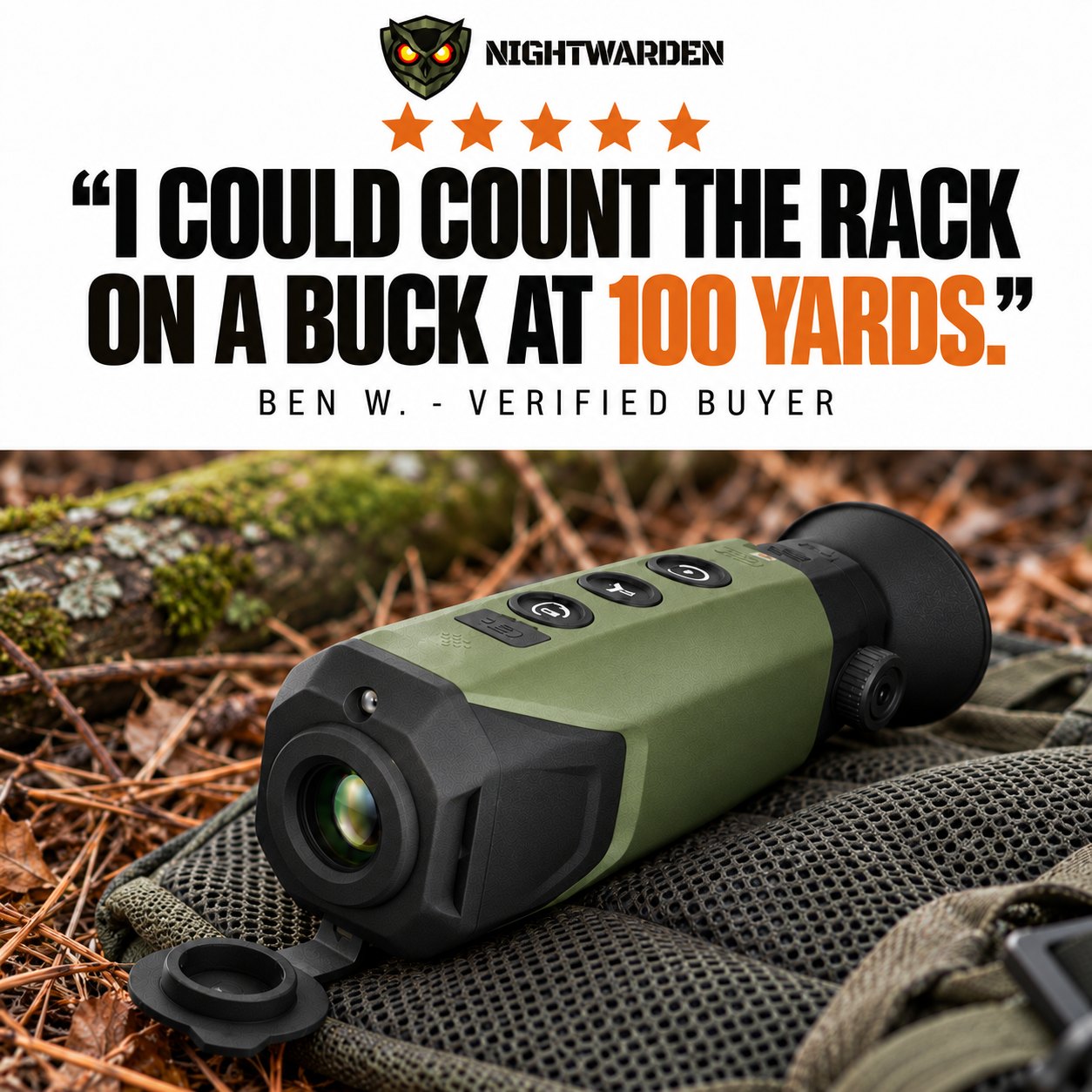
The doubt is fair. Thermal has been a $2,000 purchase for years, and a $400 unit sounds like a compromise. The numbers that decide picture quality are sensitivity and refresh rate, and Nightwarden's are the ones the expensive units advertise: NETD under 40 mK, 50 Hz, a 640×480 display behind the eyepiece. One buyer who already owned two far more expensive thermals called the clarity just as good. Another counted the rack on a buck at 100 yards. Honest limit: it's a 256×192 sensor, so past 100 yards you'll know something is there before you can say what. For spotting, scanning and knowing what walked through, that's the job.
In the Blind, on the Porch, and in the Breaker Box
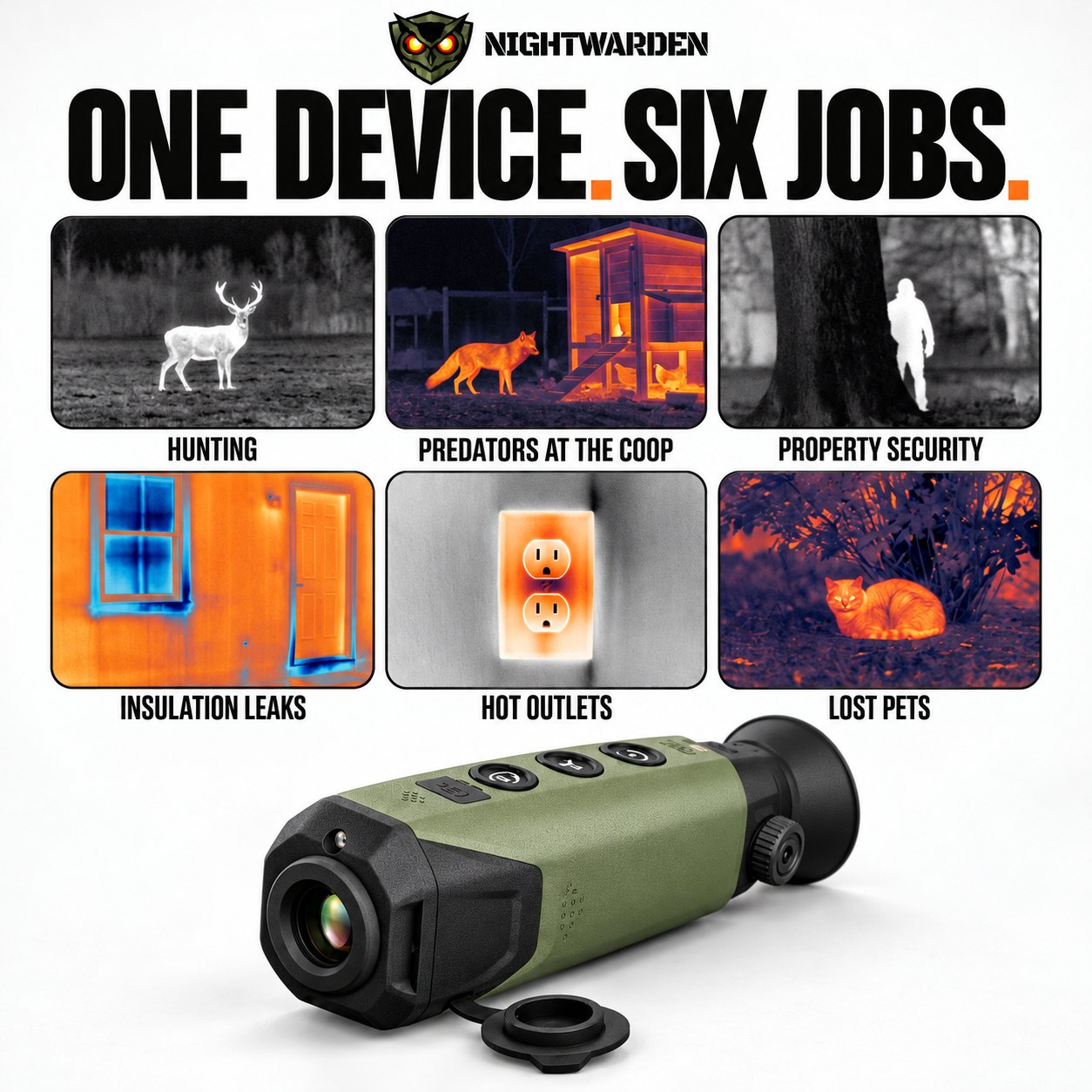
A thermal that only earns its keep in deer season ends up in a drawer by January. Nightwarden reads heat, and heat is everywhere you have a question. Hunters use it to scan a field before first light and to find a downed deer in the timber. Landowners use it to see what's circling the chicken coop and who's at the treeline. Then it comes inside: a cold draft around a window shows up as a blue seam, a hot breaker in the panel glows, and the studs behind drywall appear like an X-ray. At 310 grams it rides in a coat pocket. IP67 means rain, dust and a drop in the creek don't end the night.
THE WHOLE CASE
Four reasons, and that's the lot
One monocular, five thermal palettes, and a battery that outlasts the night.
SEE IT WORK


HOW IT WORKS
Look. Spot. Know.
Flashlights and night vision need light. Nightwarden needs a temperature difference, and everything alive has one.

Step 1 — Pick a palette
Five modes on one button. White Hot is the all-rounder: warm things glow against a dark field. Black Hot reads like night vision. Bird mode pulls small heat signatures, like a rabbit or a songbird, out of the background.
Step 2 — Scan at 1x
Set the diopter once so the display is sharp for your eye, then sweep the treeline at 1x, where the 13.5° field of view is widest. A deer at 450 yards shows as a bright shape; a person at 100 is unmistakable.
Step 3 — Zoom in and record
Step through 2x, 4x and 8x to study what you found, hit the capture button for a photo or a video with audio, or turn on the hotspot and watch it live on your phone. Everything saves to the 32 GB inside.
Look. Spot. Know.
★ 4.8/5 · Over 12,000 Sold — 450-yard detection · 50 Hz, sub-40 mK sensor · live view on your phone · 30-Night Guarantee